14 Haziran 2010 Pazartesi

SOCIOAFFECTIVE LANGUAGE LEARNING STRATEGIES
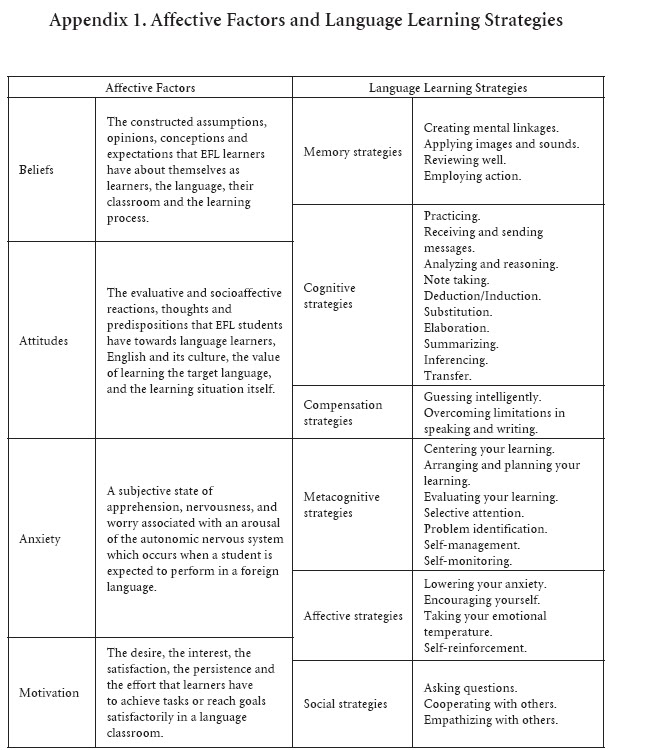
A particular action research study examined critical reflection, teacher autonomy and learner autonomy by focusing explicitly on affective factors and socioaffective language learning strategies among learners in a monolingual EFL classroom at the Centro Colombo Americano in Bogota, Colombia. The overall purpose of this action research was to explicitly teach affective factors and socioaffective language learning strategies in order to make them more accessible and usable for beginner EFL students (See appendix B). Seventeen beginner EFL students participated in this action research study. An initial semi-structured questionnaire and a rating scale gave first data on factors and strategies that needed to be addressed. Observation and teaching logs provided information about how affective-based instruction was conducted and how students responded to it. A post-questionnaire was used to determine the effectiveness and usefulness of this type of instruction.
This action research aimed at contributing theoretical findings and pedagogical suggestions to the investigation of socioaffective matters in the ESL/EFL field. It did it by first identifying and describing the beliefs, attitudes, anxieties and motivations of a group of beginner students in a three-month course. Afterwards, it analyzed what affective factors seemed to play a greater role in the language learning process of this group of beginner students. Subsequently, it implemented strategy-based instruction on socioaffective language learning strategies through affect-related activities. Then, it assessed the usefulness of affect-based instruction. On the whole, this study sought to promote a critical consciousness, which exhibited itself in new educational as well as practical actions for beginner foreign language teachers, students and classrooms.
This action research aimed at contributing theoretical findings and pedagogical suggestions to the investigation of socioaffective matters in the ESL/EFL field. It did it by first identifying and describing the beliefs, attitudes, anxieties and motivations of a group of beginner students in a three-month course. Afterwards, it analyzed what affective factors seemed to play a greater role in the language learning process of this group of beginner students. Subsequently, it implemented strategy-based instruction on socioaffective language learning strategies through affect-related activities. Then, it assessed the usefulness of affect-based instruction. On the whole, this study sought to promote a critical consciousness, which exhibited itself in new educational as well as practical actions for beginner foreign language teachers, students and classrooms.
This study adopted Anne Burns" (1999, p. 35) model of action research because it allows for practical, but critical classroom enquiry and self-reflection which provide a sound source for pedagogical planning and action (See appendix C). It also enables EFL teachers to easily frame the local decisions of the classroom within broader educational, institutional, and theoretical considerations. This study also followed and adopted Whitehead"s (1993) set of reflective questions to help the teacher-researcher to be as critical and reflective as possible because, as McNiff (2002) claimed, these questions also entail a methodology of action research in which one wants to assess and reflect about what one is doing (See appendix D). In doing this type of reflective research, one is not only giving an account of oneself, but also one is showing that one can justify what one is doing with good reason.
The results of the study suggested that explicit strategy instruction in socioaffective language learning strategies is helpful in heightening learner awareness of the importance of paying attention to their own feelings and social relationships as part of their learning process. This increased awareness about the socioaffective dimension of foreign language learning seemed to ultimately improve the frequency and the quality of students" participation and interaction in class. The results also showed that when teachers reflect on their practical pedagogical know-how, it becomes rich personal pedagogical knowledge.
I believe that action research studies on language learning strategies and affective factors make it possible for EFL students to become agents in their own learning process. Such studies can lead them to see that language learning is mainly the result of their own self-initiated interaction with their teachers, their classmates, their materials and their own personal, social, affective and cultural attributes. On the other hand, this type of studies can allow EFL teachers to critically and systematically analyze their students, identify potential problems, modify their teaching practices, and evaluate the results. EFL teachers can even face and transform their daily practices in ways which let them respond adequately to their students" needs and sociocultural agendas. In the end, action research studies on language learning strategies can help EFL teachers and students realize that they can and should be active, reflective and autonomous agents of their language teaching and learning processes.
Affective Factors and Language Learning Strategies
The affective domain or dimension of learning has been neglected by traditional methodologies. According to Feder (1987), affective factors have habitually depended on the teacher's temperament. That is to say, considerations for beliefs, attitudes, anxieties and motivations have been incidental rather than integral to the teaching methodology and have not been grounded in a conscious philosophy of pedagogy. Affective factors should not continue being considered the Cinderella of mental functions, since they "link what is important for us to the world of people, things, and happenings" (Oatley & Jenkins, 1996, p. 122 cited in Arnold, 1999, p. 2).
Concerning affection, Caine & Caine (1991, p. 82) noted: "We do not simply learn. What we learn is influenced and organized by emotions and mindsets based on expectancy, personal biases and prejudices, degree of self-esteem, and the need for social interaction[...]". Consequently, Colombian EFL teachers need to focus on tackling problems created by negative emotions and developing more positive, facilitative mind- sets in the EFL classroom.
One effective way to work with affective factors in EFL classes is the teaching of language learning strategies (LLS). According to Oxford (1990, p. 1), language learning strategies are specific actions, behaviours, steps, or techniques that students (often intentionally) use to improve their progress in developing L2 skills and communicative ability. The past three decades have seen a growing interest in studying how language learning strategies help students acquire a second or foreign language (Stawowy, 2004). LLS theorists attribute students' success rate in language learning to the varying use of strategies. Furthermore, they believe that these strategies are teachable skills, meaning that teachers can help in the language learning process by getting students aware of strategies and encouraging their use.
Thus, Colombian EFL teachers can heighten learner awareness about affection and other relevant issues (memorization, cognition, metacognition, etc) by providing strategy training as part of the foreign language curriculum
Concerning affection, Caine & Caine (1991, p. 82) noted: "We do not simply learn. What we learn is influenced and organized by emotions and mindsets based on expectancy, personal biases and prejudices, degree of self-esteem, and the need for social interaction[...]". Consequently, Colombian EFL teachers need to focus on tackling problems created by negative emotions and developing more positive, facilitative mind- sets in the EFL classroom.
One effective way to work with affective factors in EFL classes is the teaching of language learning strategies (LLS). According to Oxford (1990, p. 1), language learning strategies are specific actions, behaviours, steps, or techniques that students (often intentionally) use to improve their progress in developing L2 skills and communicative ability. The past three decades have seen a growing interest in studying how language learning strategies help students acquire a second or foreign language (Stawowy, 2004). LLS theorists attribute students' success rate in language learning to the varying use of strategies. Furthermore, they believe that these strategies are teachable skills, meaning that teachers can help in the language learning process by getting students aware of strategies and encouraging their use.
Thus, Colombian EFL teachers can heighten learner awareness about affection and other relevant issues (memorization, cognition, metacognition, etc) by providing strategy training as part of the foreign language curriculum
Factors & Filters
Affective factors relate to the learner's emotional state and attitude toward the target language. Research on affect in language learning is still strongly influenced by Bloom's taxonomy, which describes the affective levels of receiving, responding, valuing, organization, and self-characterization through one's value system. It has also been informed in recent years by research in neurobiology and neurolinguistics.
Affective Filter Furthermore, researchers believe that language learners all possess an affective filter which affects language acquisition. If a student possesses a high filter they are less likely to engage in language learning because of shyness, concern for grammar or other factors. Students possessing a lower affective filter will be more likely to engage in learning because they are less likely to be impeded by other factors. The affective filter is an important component of second language learning.
Affective Filter Furthermore, researchers believe that language learners all possess an affective filter which affects language acquisition. If a student possesses a high filter they are less likely to engage in language learning because of shyness, concern for grammar or other factors. Students possessing a lower affective filter will be more likely to engage in learning because they are less likely to be impeded by other factors. The affective filter is an important component of second language learning.
Affective factors
Affective factors are emotional factors which influence learning. They can have a negative or positive effect. Negative affective factors are called affective filters and are an important idea in theories about second language acquisition.
A learner's attitude to English, to the teacher, to other learners in the group and to herself are all affective factors and have impact on how well she learns.
Affective factors may be as important for successful language learning, if not more so, than ability to learn. Teachers can reduce negative factors and develop positive ones by doing activities to build a positive group dynamic, by including students in deciding aspects of the course and choosing activities that are motivating for the age and interests of the learners.-
A learner's attitude to English, to the teacher, to other learners in the group and to herself are all affective factors and have impact on how well she learns.
Affective factors may be as important for successful language learning, if not more so, than ability to learn. Teachers can reduce negative factors and develop positive ones by doing activities to build a positive group dynamic, by including students in deciding aspects of the course and choosing activities that are motivating for the age and interests of the learners.-
Kaydol:
Kayıtlar (Atom)